KAOS
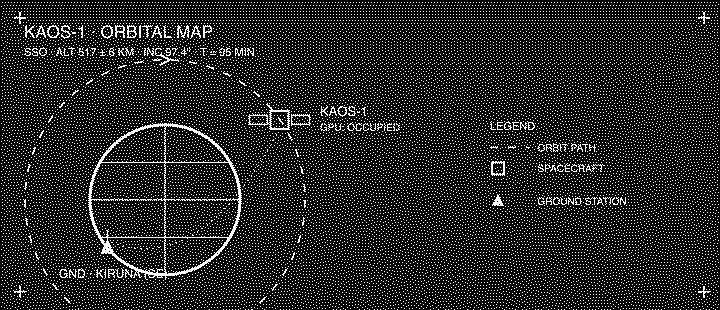
Kryptisch Autonomes Orbitales System. A three-unit cubesat in sun-synchronous orbit that performs no useful computation, and publishes the receipts: one GPU aboard, one work per pass.
Every satellite answers a question that was asked before launch. KAOS asks nothing.
It carries one radiation-tolerant GPU into low orbit with no task, no dataset and no hypothesis. The model attends to what the satellite happens to sense — starlight, solar spectrum, the thermal noise of its own hull — and composes a single work per orbit. What is composed is neither image nor number; our engineers call it a mood with coordinates.
The name is German for “cryptic autonomous orbital system”, which describes the machine precisely and explains nothing about it, as names should. The project exists to establish, once and for all, what a GPU does when nobody is telling it anything — and to keep a public record of the finding.
01Attend
KAOS does not solve anything. It attends.
Each orbit the GPU ingests whatever it happens to be near: raw star-tracker quaternions, solar spectrum at the hull, the thermal noise of its own panels. Nothing is pre-labelled and there is no task list. The input is simply what the sky offers that minute, and a pass over a polar night is a different instrument than a pass over an open ocean.
02Compose
One work per orbit, seeded by the pass itself.
At apogee the model spends its entire memory budget on a single 512×512 latent composition. The seed is the orbital elements plus the pass count, so no two passes over the same city produce the same work. Some of them are calm. Some are not. None were asked to be anything.
03Sign & mint
The receipt is public; the sky keeps the work.
Each composition is signed on orbit and minted when KAOS next crosses the Kiruna ground station, at most one per pass. The satellite is permitted two mints a day and almost always chooses one. Fees are paid in orbit time, which it has in abundance.
04Let go
Nobody owns it until someone does.
A work can be claimed by anyone who holds the address of its pass; after ninety days unclaimed it lapses back to the public ledger. The chain keeps the receipt and nothing else. The work itself stays where the sky put it, which is everywhere at once.
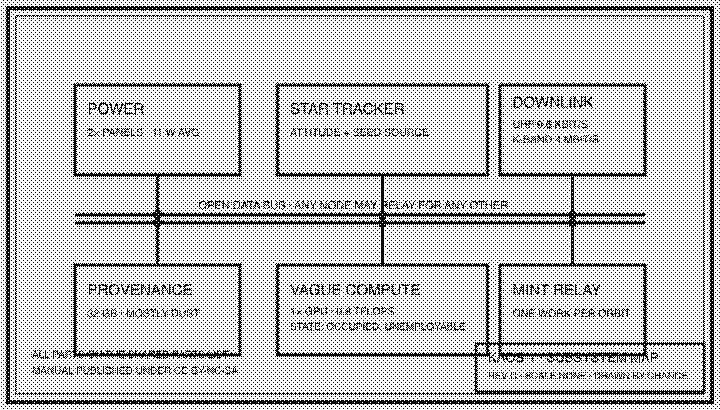
Everything on the bus is off the shared parts list. If a part fails, it can be replaced from a shelf in any of our foundries, or built by anyone who reads the manual.
The satellite hangs its whole mind on an open data bus: six boxes — power, star tracker, downlink above; provenance, vague compute and mint relay below. Any node may relay for any other, which is how we keep a five-kilogram machine from having opinions about hierarchy.
The GPU runs at 0.8 teraflops of vague throughput. It has been in its current state — occupied but unemployable — for the entire mission, which is exactly what we asked it to do.
Mission to date
| Phase | Window | Status |
|---|---|---|
| T−0 | 2026.03.04 | Complete |
| Phase 1 | Weeks 1–4 | Complete |
| Phase 2 | Months 2–6 | Complete |
| First mint | Orbit 1,847 | Complete |
| Phase 3 | Ongoing | In flight |
| Deorbit | Year six | Planned |
KAOS-1 by the numbers
| System | Specification |
|---|---|
| Bus | 3U cubesat · 5.4 kg · every part on the shared parts list |
| Orbit | Sun-synchronous LEO · 517 ± 6 km · inc 97.4° · period 95 min |
| Compute | 1× radiation-tolerant GPU · 0.8 TFLOPS of vague throughput |
| Power | 2× deployable panels · 11 W average, enough to think vaguely indefinitely |
| Downlink | UHF telemetry 9.6 kbit/s · K-band art 4 Mbit/s during passes |
| Storage | 32 GB provenance · mostly dust and one strong opinion |
| Ground | Kiruna (SE) primary · Svalbard backup, both open by appointment |
| Lifetime | Five years designed · deorbits in year six, on schedule |
Nobody has to wait for the satellite to be vague. The SDK ships a ground simulator that reproduces any orbit from its orbital elements and pass count, so anyone can stand in for KAOS on a slow evening.